





There’s a 900-year-old idol in a small Maharashtra town that still gets dressed, bathed, and put to bed every single day – and there’s a fair chance you’ve never heard of the town it lives in.
That town is Barshi Maharashtra, and it’s the quiet starting point of one of India’s most authentic, least-Instagrammed pilgrimage routes: a three-stop trail through Barshi, Tuljapur, and Pandharpur that traces nearly a thousand years of unbroken devotion. No five-star resorts. No curated influencer backdrops. Just centuries-old rituals, still running exactly on schedule, in towns most travel guides never mention. If you want to feel India rather than just photograph it, this is the route.
The circuit covers Barshi’s Bhagwant Mandir (a Vishnu temple dating to 1245 A.D.), Tuljapur’s Tulja Bhavani Temple (a 12th-century Shakti Peetha linked to Chhatrapati Shivaji Maharaj), and Pandharpur’s Vitthal-Rukmini Temple (the emotional heart of Maharashtra’s Warkari tradition). Give yourself 3 – 4 days, travel between October and March, and plan around Ekadashi if you want to witness the festivals firsthand.
Barshi Maharashtra: Quick Facts Before You Go
Before diving into temple history, here’s the practical groundwork every traveler searching for Barshi Maharashtra actually needs.
Where is it : Barshi sits in Solapur district, Maharashtra, and serves as the headquarters of Barshi Taluka.
What’s the Barshi pin code : The main town is covered under PIN code 413401, with nearby localities falling under 413411, as listed by The Weather Channel’s location data for Barshi. Knowing the correct Barshi pin code matters if you’re booking couriers, hotels, or even SIM registration during your visit.
What’s Barshi weather like? : Barshi has a subtropical steppe (semi-arid) climate, with an average annual temperature around 29°C and comparatively low yearly rainfall of roughly 103 mm, according to climate data from WeatherAndClimate.com. Translation: expect dry heat for most of the year, with summers (April–June) climbing well past 40°C.
Best time to visit: October to March, when Barshi weather cools down enough for comfortable temple-hopping and walking tours.
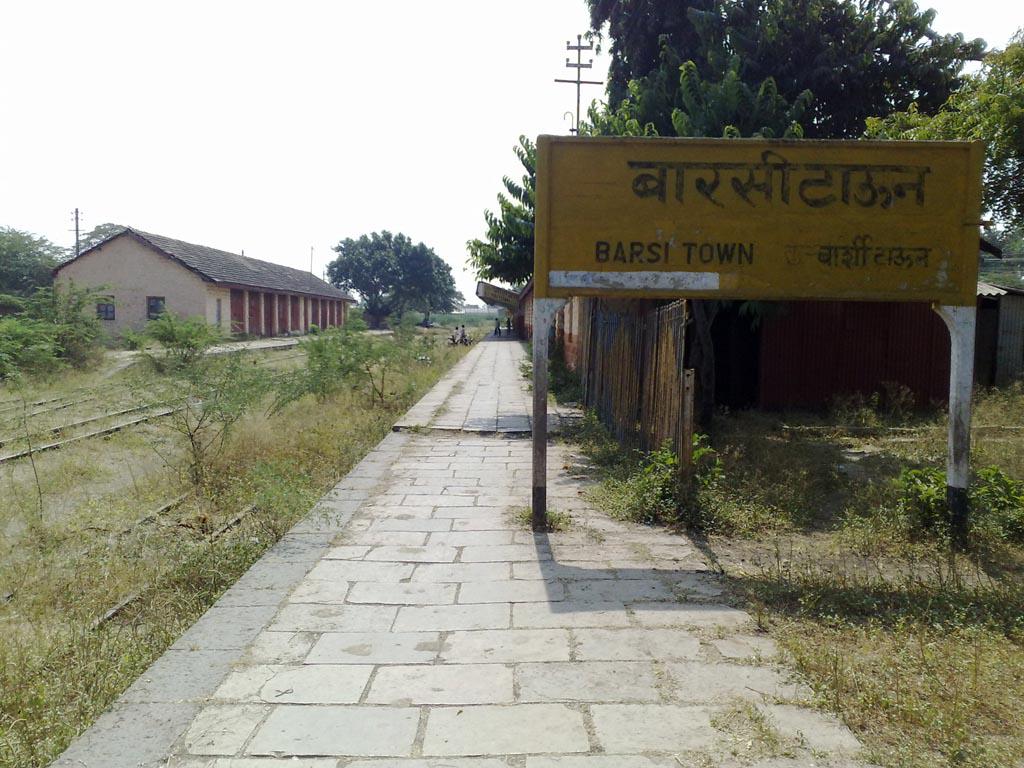
Why Barshi Maharashtra Deserves the First Stop
Most travelers driving between Solapur and Pandharpur zip straight past Barshi Maharashtra without a second thought – which is exactly what makes stopping here worthwhile. Its centerpiece, the Bhagwant Mandir, dates to 1245 A.D. and is built in the region’s distinctive Hemadpanthi stone style. What makes it genuinely rare isn’t its size; it’s reportedly the only Vishnu temple in India where the deity carries the name “Bhagwant,” according to information published by the Solapur district administration.
The idol is carved from black stone, holding Vishnu’s traditional symbols – the conch, discus, and mace – with devotee-king Ambrish depicted near his hand and Goddess Lakshmi on the reverse. Historical land-grant records cited by the district government trace royal support for the temple across three very different ruling powers: the Peshwa administration in 1760, the East India Company in 1823, and the British colonial government in 1784 – a small but striking timeline of how power shifted hands in this corner of the Deccan.
Answer Box – What Is Barshi Famous For?
Barshi Maharashtra is best known for the Bhagwant Mandir, its unique dal (lentil) processing industry, and its powerloom weaving tradition – making it as much a commercial hub as a spiritual one.
If you’re timing your trip around a festival, the temple’s calendar peaks during the four major Ekadashi days: Chaitri, Maghi, Aashadi, and Kartiki – when the idol is taken through town in procession. Round out your visit with Bhuikot Fort, the Ganpati and Dattatreya temples, and nearby Jain shrines including Parasnath and Adinath Mandir.
Stop Two: Tuljapur and the Goddess Who Moves
From Barshi, it’s roughly a two-hour drive to Tuljapur, home to one of Maharashtra’s most historically significant shrines: the Tulja Bhavani Temple. Built in the 12th century under the Kadamba dynasty, it’s recognized as one of Maharashtra’s Shakti Peethas – sites believed to hold the living presence of the goddess Shakti, according to Outlook Traveller’s temple guide.
What makes Tuljapur fascinating even for visitors with no religious background is its connection to Chhatrapati Shivaji Maharaj, the 17th-century Maratha king who revered the goddess as his spiritual protector before launching his campaign for self-rule. The idol itself is also unusual: unlike most fixed temple deities, Tulja Bhavani is considered a “chala,” or mobile goddess – her black-stone, eight-armed form is physically moved from her throne several times a year. The Maharashtra Tourism Department lists Navratri (September – October) as the most spiritually charged – and busiest – time to visit.
Stop Three: Pandharpur, the Emotional Finale
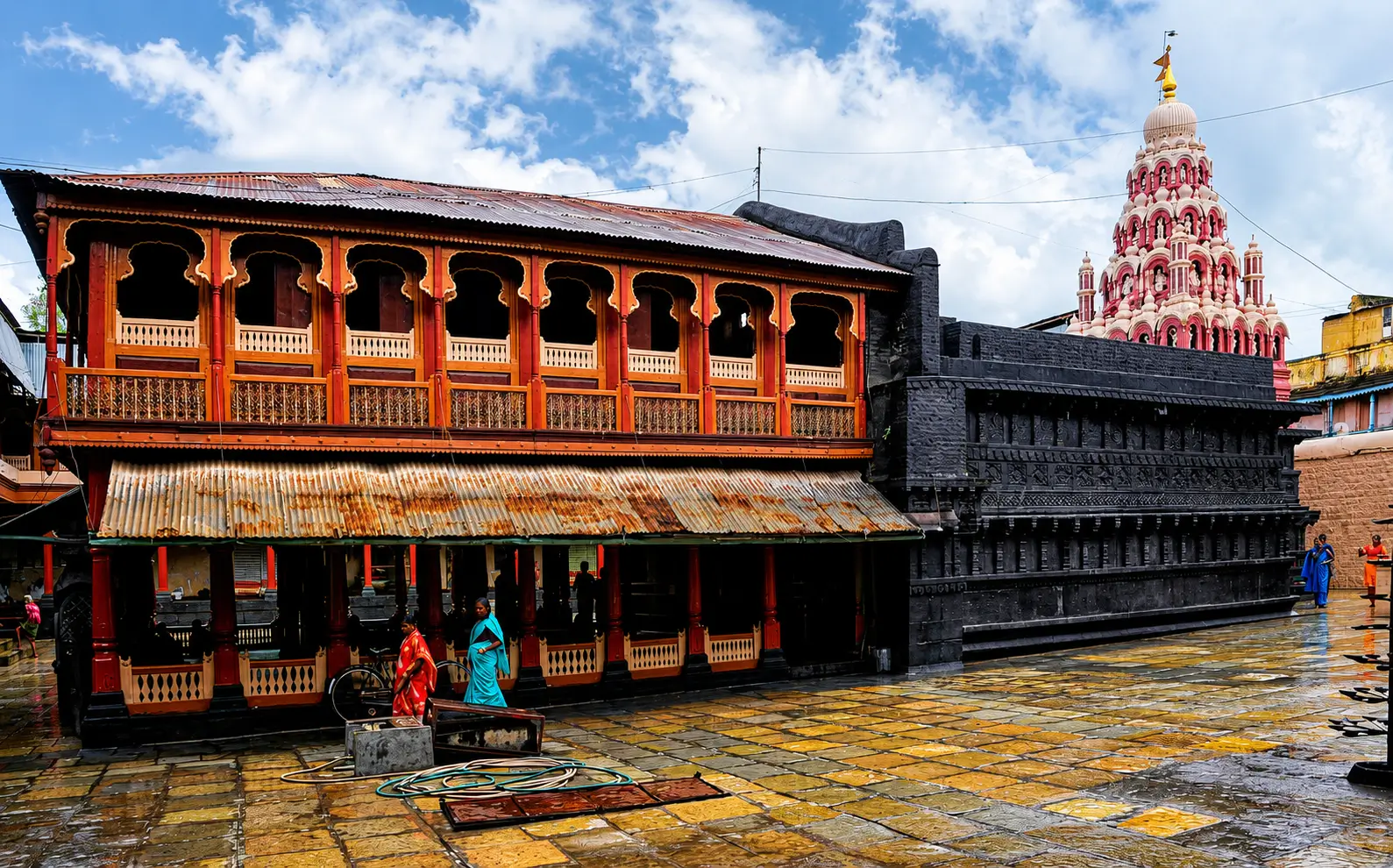
The circuit builds toward Pandharpur, often called the spiritual capital of Maharashtra. The town’s Vitthal-Rukmini Temple traces back to the 12th century, later shaped by contributions from the Peshwas of Pune and the Shinde and Holkar dynasties, according to Maharashtra Tourism’s official page.
This is where the trip stops being just architecture and becomes something you witness firsthand. Twice a year, during Ashadhi (June – July) and Kartiki (October – November) Ekadashi, hundreds of thousands of pilgrims called Warkaris walk barefoot into town, singing devotional songs and carrying palanquins linked to poet-saints Dnyaneshwar and Tukaram – a tradition called the Wari, documented by Britannica. It’s one of the largest annual walking pilgrimages on Earth, and it rarely makes international headlines. Notably, in 2014 this temple became the first in India to formally allow women and people from historically marginalized communities to serve as priests – a modern footnote on an ancient institution.
Planning the Circuit: A Fast-Answer Checklist
– Duration: 3–4 unhurried days (half-day Barshi, overnight Tuljapur, full day Pandharpur).
– Best season: October–March, when Barshi weather and the wider Solapur–Dharashiv belt are at their most comfortable.
– Nearest airports: Pune and Solapur.
– Dress code: Modest clothing; be ready to remove footwear frequently.
– Festival planning: Build your trip around Ekadashi dates for the fullest cultural experience – or avoid them if you prefer smaller crowds.
It’s not a five-star holiday. It’s something rarer: a chance to walk through thirteen centuries of unbroken faith, one honest, dusty town at a time – starting with Barshi Maharashtra.
FAQs About Barshi Maharashtra and the Pilgrimage Circuit
Q1. What is the PIN code of Barshi, Maharashtra?
The Barshi pin code is 413401 for the main town, with 413411 covering nearby areas.
Q2. What is Barshi weather like for travelers?
Barshi weather is hot and dry most of the year (semi-arid/steppe climate), with the most comfortable travel window between October and March.
Q3. Is Barshi Maharashtra worth visiting on its own, or only as part of the circuit?
Barshi Maharashtra works well both ways – as a standalone day trip from Solapur, or as the opening stop of the wider Tuljapur–Pandharpur pilgrimage circuit.
Q4. Do I need to be Hindu to visit these temples?
No – all three temples welcome visitors of any background, though modest dress and respectful conduct are expected.
Q5. Is this pilgrimage circuit safe and manageable for first-time or solo travelers?
Yes, the region is well-connected by road and rail, though English signage is limited, so a local guide or driver is helpful.