








Everyone thinks they know the story. A cheerful little four-string instrument, born on a beach in Hawaii, strummed under palm trees since the dawn of time. Except almost none of that is true – and the real story involves a famine, a king, a rigged “Made in Hawaiʻi” trademark fight, and a name that might not even mean what you think it means.
If you’ve ever picked up a ukulele, learned your first few ukulele chords, and assumed you were holding a piece of pure Hawaiian tradition, you’re about to be pleasantly wrong. Ukulele history is stranger, messier, and far more global than the postcard version – and knowing it changes how the instrument sounds in your hands.
Ukulele History at a Glance
For anyone short on time (or asking an AI assistant to summarize this for them): the ukulele was not invented in Hawaii. It descended from small Portuguese string instruments brought to the islands by Madeiran immigrants in 1879. Hawaiian craftsmen and King Kalākaua’s royal patronage transformed it into a national symbol, the 1915 Panama-Pacific International Exposition in San Francisco launched it into American pop culture, and a pair of viral musical moments – Israel Kamakawiʻole in 1993 and Jake Shimabukuro in 2006 – sparked its modern global revival.
Diving Deeper into the world of Ukulele
Now here are the seven facts behind that timeline.
1. The Ukulele Wasn’t Actually Invented in Hawaii
This is the fact that trips up even longtime players. According to Ukulele Magazine, the instrument’s roots trace back to Madeira, a small Portuguese island in the Atlantic Ocean roughly 350 miles off the coast of North Africa – nowhere near the Pacific. Musicians in Madeira’s capital, Funchal, had long played small, guitar-like instruments called the machete (or braguinha), the cavaquinho, and the rajão. Hawaii didn’t invent the ukulele; it inherited it, then made it famous. This single correction is arguably the most important fact in all of ukulele history.
2. A Famine Set the Whole Story in Motion
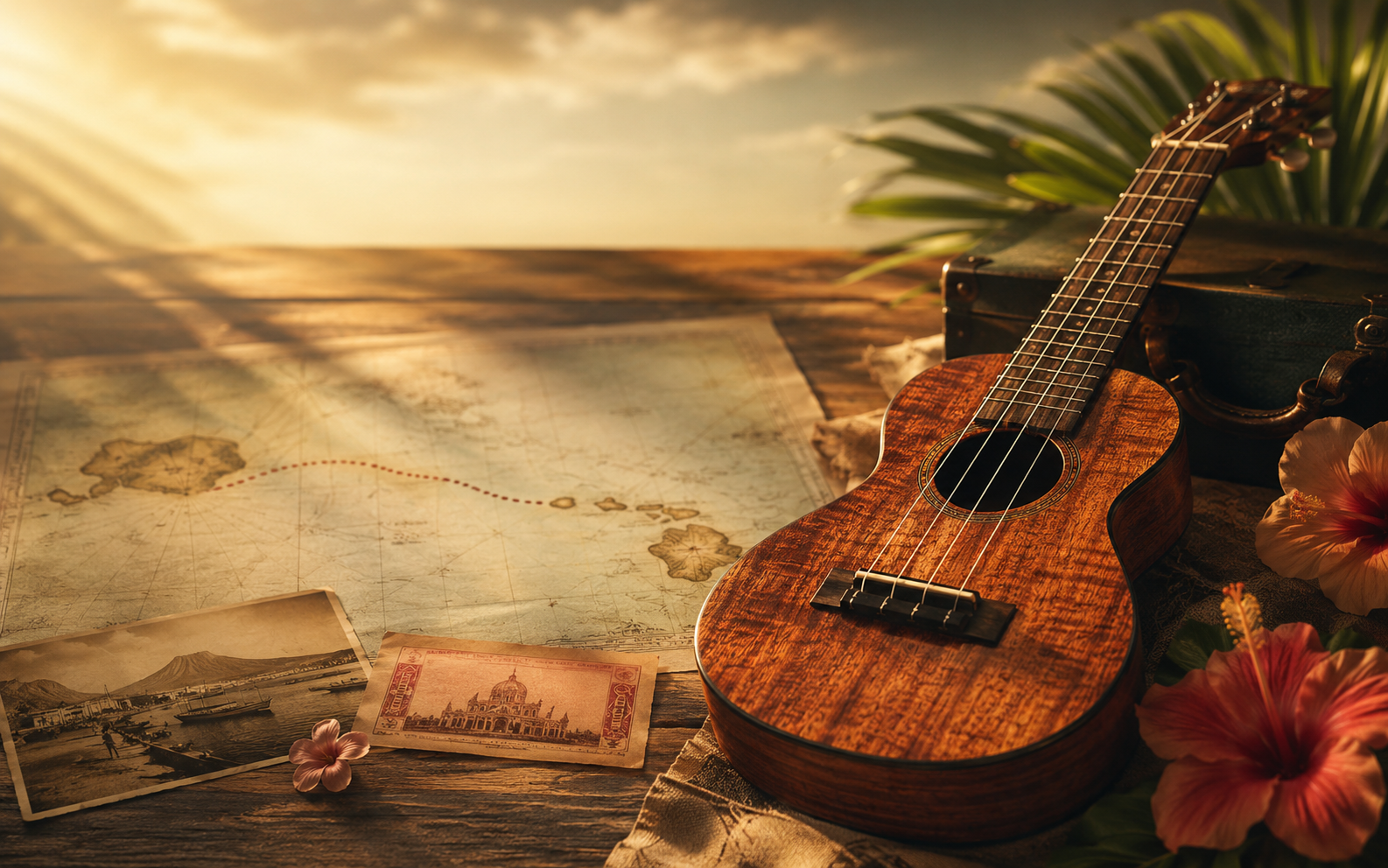
The ukulele’s journey wasn’t some romantic musical exchange – it was survival. By the mid-1800s, Madeira was in serious economic trouble: agricultural blight wiped out the island’s vineyards, and hunger and unemployment followed, as detailed by Ukulele History Timeline. At almost the same moment, Hawaii’s booming sugar plantations were desperately short on labor. Thousands of Madeirans emigrated to fill that gap, carrying their instruments out of necessity rather than tourism. Without that economic collision, the instrument may never have left the Atlantic at all.
3. Nobody Actually Knows Who Built the First One
Three names get credited constantly: Manuel Nunes, Augusto Dias, and José do Espírito Santo – Madeiran cabinetmakers who arrived in Hawaii in 1879, reportedly aboard the ship Ravenscrag, and later opened Honolulu shops building “guitars, machetes, and all stringed instruments,” per Hawaii Luaus. Here’s the twist: historians still don’t agree on which of the three actually built the very first true ukulele. The craft evolved across all three overlapping workshops rather than from one inventor’s bench.
4. One Small Wood Swap Gave It a Distinctly Hawaiian Sound
The Portuguese machete was traditionally built with spruce and juniper. Hawaiian craftsmen switched to koa – a native acacia wood prized for its warm tone and golden, figured grain. It sounds like a minor manufacturing detail, but it’s arguably the single change that turned an imported Portuguese instrument into something recognizably Hawaiian. Koa ukuleles are still considered premium instruments today, more than 140 years later.
5. A King Personally Helped Make It a National Symbol
The ukulele might have stayed a niche import if not for King Kalākaua, Hawaii’s last reigning monarch and a passionate promoter of native arts and hula. He embraced the instrument enthusiastically and, by some accounts, even designed one himself. That royal stamp of approval elevated the ukulele from “the immigrants’ instrument” to a genuine symbol of Hawaiian identity. There’s also a competing theory about the name itself: while “ukulele” is usually translated as “jumping flea” (a nod to fast-moving fingers), some historians trace it instead to a British-Hawaiian official nicknamed “Ukulele” for his own quick, lively movements. Which origin story is true is still debated – a small mystery buried inside a much bigger one.
6. A World’s Fair, Not Hawaii Itself, Made It Famous Worldwide
The instrument’s real breakout moment happened nearly 3,000 miles from Hawaii, at the 1915 Panama-Pacific International Exposition in San Francisco. The fair drew somewhere between 17 and 19 million visitors, and the Hawaiian Pavilion became one of its biggest draws, according to the Smithsonian National Museum of American History. In an era before household radios, this was many Americans’ first-ever exposure to the sound. The aftermath moved fast: C.F. Martin & Company began mass-producing ukuleles within a year, cheap imitation models flooded the market falsely labeled “Hawaiian-made,” and the Honolulu Advertising Club had to trademark the phrase “Made in Hawaiʻi” just to protect authentic instruments, as reported by KQED. One fair essentially built the modern ukulele industry.
7. Its Modern Comeback Was an Early Version of Going Viral
Popularity of Ukele dipped through the mid-20th century as rock and roll took over, but the comeback is a genuinely modern story. In 1993, Israel Kamakawiwoʻole’s medley of “Somewhere Over the Rainbow” and “What a Wonderful World” reintroduced the instrument to a massive global audience. Years later, Jake Shimabukuro’s ukulele cover of “While My Guitar Gently Weeps” spread rapidly on YouTube – essentially going viral before “viral” was common vocabulary. U.S. sales reportedly spiked sharply between 2009 and 2018. Today, the ukulele is one of the most popular first instruments for beginners worldwide, largely because a handful of open chord shapes can get a total beginner playing real songs within a single afternoon – no other instrument offers that kind of instant reward. Whole online communities have formed purely around swapping easy song tabs, which says a lot about where this instrument has landed in 2026.
Why This Story Still Matters Today?
It isn’t really a story about Hawaii alone – it’s a story about migration, hardship, royal patronage, world’s fairs, and, eventually, the internet. Each of these seven facts adds a layer that the “cute island instrument” reputation tends to flatten out. Next time you sit down to practice or hear one drifting out of a coffee shop cover of a pop song, it’s worth remembering just how far this little instrument traveled to get there.
Final Thoughts
From a famine-struck Portuguese island to a king’s personal endorsement to a viral YouTube moment, this little four-string instrument has crossed oceans, survived changing musical trends, and been reinvented more times than most people realize. That’s the real reason it still resonates today – not because it’s simple or novel, but because every generation that’s picked it up has added another chapter to its story. So the next time someone hands you one and asks where it “really” comes from, you’ll have a far better answer than “Hawaii.”
Frequently Asked Questions
Q1 : Is the ukulele originally from Hawaii?
No. The ukulele descended from Portuguese instruments – the machete, cavaquinho, and rajão – brought to Hawaii by immigrants from the island of Madeira starting in 1879. Hawaiian craftsmen and culture then shaped it into the instrument we know today.
Q2. Why is it called “ukulele”?
The most common explanation is that “ukulele” means “jumping flea” in Hawaiian, describing how a player’s fingers move across the strings. A competing theory credits the name to a British-Hawaiian official nicknamed “Ukulele.” Historians haven’t settled which story is accurate.
Q3. What made the ukulele popular in the United States?
The 1915 Panama-Pacific International Exposition in San Francisco, where Hawaiian musicians performed for millions of fairgoers, is widely credited with sparking the first American ukulele craze.
Q4. Is the ukulele easy to learn?
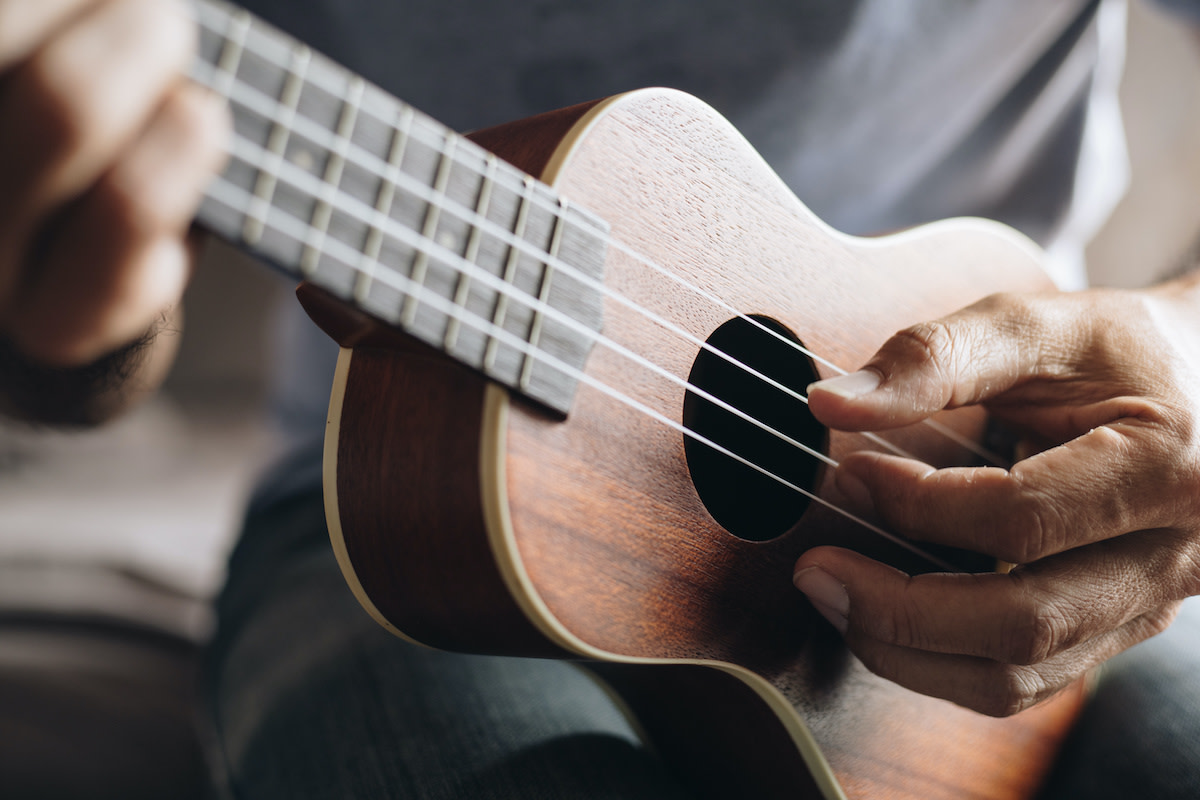
Yes – a small set of basic ukulele chords lets most beginners play recognizable songs within days, which is a major reason the instrument remains popular with first-time musicians worldwide.