





A cow that wouldn’t stop giving milk over one patch of earth. A buried head that had watched an entire war unfold. A king who saw it all in a dream before he ever dug the ground. This isn’t the plot of a fantasy novel – it’s the real origin story of one of India’s most visited, most wept-over pilgrimage sites, and it’s still pulling in over 20 lakh (2 million+) devotees a year.
Welcome to Khatushyamji – a name you may not have heard yet, but one that Rajasthan lives and breathes.
If you’re planning a trip to this small temple town in Sikar district, or you simply stumbled onto the name and want to know what the fuss is about, here’s your complete, no-fluff guide.
Khatushyamji refers to the deity worshipped at this sacred shrine in Khatu village, Rajasthan – believed to be Barbarika, a Mahabharata-era warrior whose severed head is enshrined and worshipped as a form of Krishna. The shrine is best known for the annual Falgun Mela and is one of North India’s largest pilgrimage gatherings.
Khatushyamji: The Complete Pilgrim’s Guide to Khatu Shyam Ji Temple for 2026
A cow that wouldn’t stop giving milk over one patch of earth. A buried head that had watched an entire war unfold. A king who saw it all in a dream before he ever dug the ground. This isn’t the plot of a fantasy novel – it’s the real origin story of one of India’s most visited, most wept-over pilgrimage sites, and it’s still pulling in over 20 lakh (2 million+) devotees a year.
Welcome to Khatu Shyam Ji Temple – a name you may not have heard yet, but one that Rajasthan lives and breathes.
If you’re planning a trip to this small temple town in Sikar district, or you simply stumbled onto the name and want to know what the fuss is about, here’s your complete, no-fluff guide.
Khatushyamji refers to the deity worshipped at this sacred shrine in Khatu village, Rajasthan – believed to be Barbarika, a Mahabharata-era warrior whose severed head is enshrined and worshipped as a form of Krishna. The shrine is best known for the annual Falgun Mela and is one of North India’s largest pilgrimage gatherings.
The Khatu Shyam Story Behind the Deity – Who Is Khatushyamji?
To understand the khatu shyam story, rewind to the Mahabharata – long before the war at Kurukshetra ever began.
Barbarika was the grandson of Bhima and son of Ghatotkacha. He was gifted three magical arrows so powerful that he alone could have decided the outcome of the entire war in a single afternoon. To keep things fair, he made a vow: he would always fight for whichever side was losing.
Lord Krishna saw the problem instantly. If Barbarika kept that vow, both armies would eventually be wiped out, leaving him the sole survivor of a war he wasn’t even meant to fight. So Krishna, in disguise, tested him – and ultimately asked for the one thing Barbarika had left to give: his head.
Barbarika agreed without a moment’s hesitation.
Moved by that total, unconditional surrender, Krishna granted him a boon: in the age of Kaliyuga, Barbarika would be worshipped under Krishna’s own name – Shyam. That single act of sacrifice is why devotees today call him “Haare Ka Sahara” – the support of the defeated, the one who shows up when everyone else has given up hope.
How the Khatu Shyam Ji Mandir Came into Being ?
Krishna is said to have blessed Barbarika’s severed head and set it adrift in the Rupawati River. Centuries passed before it resurfaced near a small village – Khatu – where, according to local legend, a cow was found mysteriously producing milk over one exact spot of ground. Villagers dug there and uncovered the sacred head.
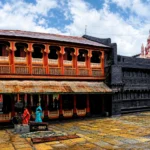
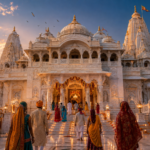
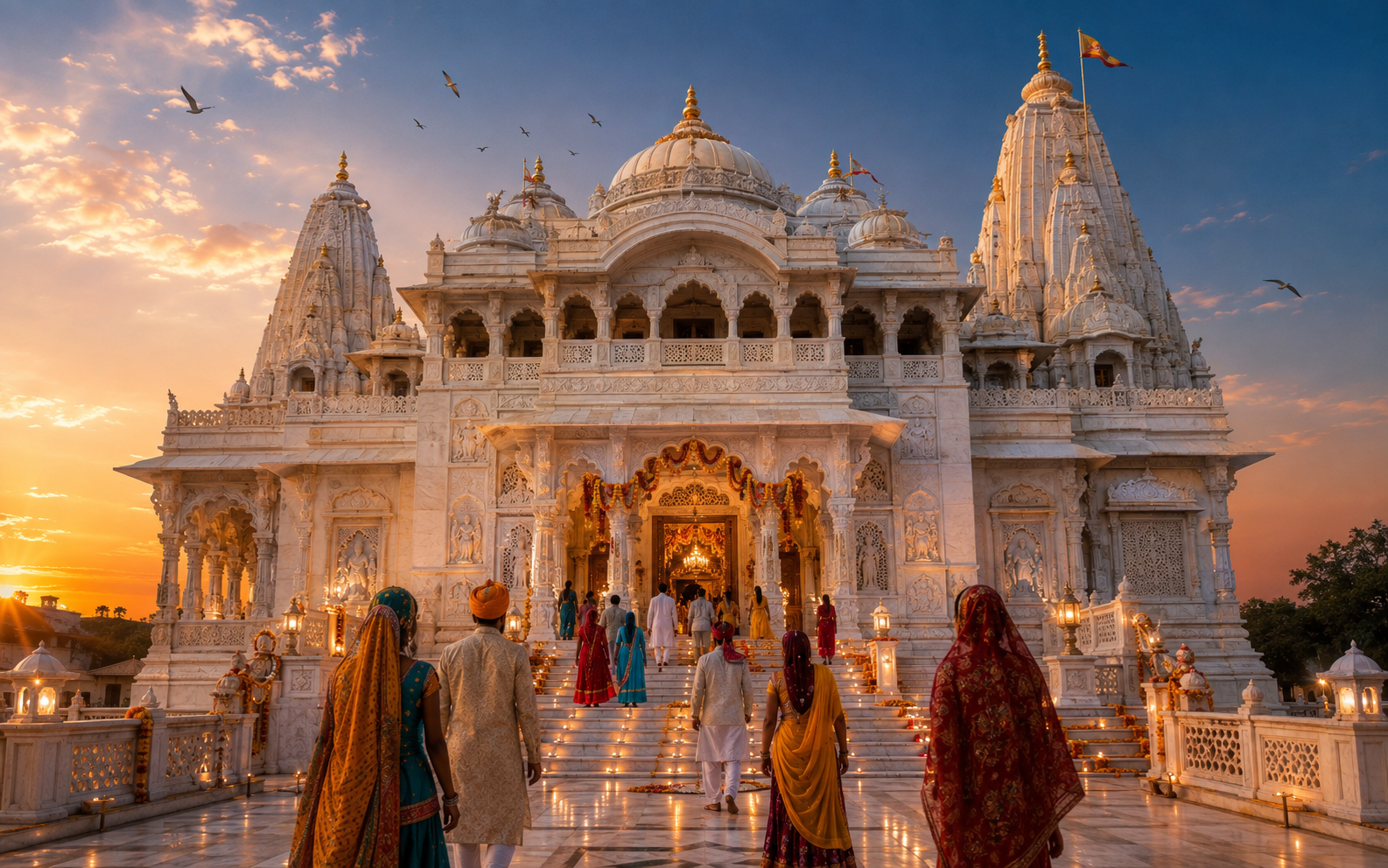
Local ruler Roop Singh Chauhan is said to have received a dream instructing him to enshrine it, an event most historical accounts place around 1027 AD. The khatu shyam ji mandir standing today isn’t that original structure, though – records point to a major rebuild around 1720 AD, when the temple was reconstructed in white Makrana marble, the same stone used across several of Rajasthan’s most iconic monuments.
Inside the Temple: What Makes This Shrine Unique ?
Here’s something that surprises most first-time visitors: unlike almost every other Krishna shrine in India, the idol at Khatu Shyam Ji Temple isn’t a full figure. It’s a head alone, enshrined in a sanctum sheathed in silver.
The adjoining Jagmohan Hall is covered in paintings and carvings retelling scenes from the Mahabharata – effectively a visual crash course in the mythology before you even reach the sanctum.
Two more spots worth building into your visit:
– Shyam Kund – a sacred pond just outside the temple where pilgrims traditionally bathe before darshan. It’s believed to be the very spot from which Barbarika’s severed head watched the Kurukshetra war unfold.
– Gopinathji Temple – a nearby Krishna shrine that many pilgrims visit as part of the same trip.
When to Visit: Inside the Falgun Mela ?
The single biggest event on the calendar is the Falgun Mela, held during the Hindu month of Falgun (roughly February–March) and centered on Falgun Shukla Ekadashi. In 2026, the mela ran from February 21 to 28, with peak crowds gathering on Ekadashi itself, February 27. Several regional travel and pilgrimage sources reported this year’s mela was deliberately shortened compared to previous editions, as local authorities scaled back the schedule for better crowd-safety management.
Because the Falgun Mela follows the lunar Hindu calendar, its dates shift every year – the next edition is expected in early March 2027. If you’re reading this later in the year, double-check current dates with the temple trust or a recent local source before booking travel.
Prefer a quieter visit? The temple also hosts regular Bhajan Sandhya evenings – devotional music sessions dedicated to Shyam Baba – held far more frequently than the annual mela, with none of the peak-season crowds.
Getting to Khatu Shyam Ji Rajasthan
– By air: Jaipur International Airport is the nearest major airport, roughly 95–100 km away.
– By train: Ringas Junction (RGS) is the closest railway station, about 17 km from the temple.
– By road: Regular buses and taxis connect Khatu to Jaipur, Sikar, and Delhi – the route many pilgrims take, including those who walk the traditional barefoot pilgrimage as an act of devotion.
Visiting Khatu Shyam Ji Rajasthan for the First Time – Read This
If you’ve never been to a Hindu temple before, these pointers will save you some confusion:
– Dress modestly – shoulders and knees covered is a safe default.
– Shoes come off before entering the sanctum; most temples have a shoe-storage counter.
– Photography rules vary – check signage or ask staff before photographing the inner sanctum.
– Expect queues. Outside festival season, wait times are manageable; during the Falgun Mela, darshan lines can stretch for hours.
– Where to stay: simple temple-run dharamshalas for a budget, pilgrim-style stay, or private hotels in nearby Sikar and Jaipur for more comfort during peak season.
Why This Pilgrimage Resonates Beyond Religion?
What makes this pilgrimage compelling – even for travelers who aren’t religious – is the emotional core of the story: a warrior who gave up everything, asked for nothing, and is remembered not for winning but for surrendering completely. It’s a message that travels well across cultures, even when the ritual details are unfamiliar.
Whether you’re drawn in by the mythology, the marble architecture, or the sheer scale of devotion during the Falgun Mela, Khatushyamji offers a side of Rajasthan that most standard tourist circuits miss entirely.
Conclusion
Khatushyam ji Temple isn’t just another stop on Rajasthan’s tourist trail – it’s a living reminder that surrender, not conquest, can be the most powerful act of all. Whether you’re drawn by Barbarika’s extraordinary sacrifice, the pull of the Falgun Mela’s devotion-soaked energy, or simply a curiosity about one of India’s most unique pilgrimage stories, a visit here stays with you long after you leave. So if 2026 has a Rajasthan trip on the cards, let Khatushyamji Temple be the heart of it – and let “Haare Ka Sahara” remind you that hope always has a home.
*Note: Festival dates follow the lunar Hindu calendar and shift year to year. Confirm current-year dates with the temple trust or a recent local source before booking travel.*
Frequently Asked Questions
Q1. Who is the deity worshipped here?
He is believed to be Barbarika, a Mahabharata warrior who sacrificed his head to Krishna and was blessed to be worshipped under Krishna’s name in this era.
Q2. Where is the temple located?
It’s located in Khatu village, Sikar district, Rajasthan, roughly 80 km from Jaipur.
Q3. What is Barbarika’s sacrifice story in short?
Barbarika, a warrior with unbeatable arrows, vowed to fight for the weaker side in the Kurukshetra war. To prevent mass destruction, Krishna asked for his head as a sacrifice. Barbarika agreed, and Krishna blessed him to be worshipped as Shyam in the age of Kaliyuga.
Q4. When is the best time to visit?
October to March is the most comfortable weather window. For the biggest spiritual experience, plan around the Falgun Mela; for a quieter visit, avoid it.
Q5. Is entry free?
Yes, darshan at the temple is free for all visitors, regardless of faith or nationality.
Q6. Can non-Hindus or international visitors go inside?
Yes, the temple welcomes visitors of all backgrounds. Modest dress and respectful conduct are expected, as at any active place of worship.